
With the increasing awareness of environmental protection and the maturity of renewable energy technology, solar courtyard lights have been widely used in residential yards, commercial plazas, park green spaces, rural trails and other scenarios due to their core advantages of “zero electricity bills, easy installation and low maintenance”. This article analyzes the selection logic, installation details, usage effects and energy-saving & environmental protection value of solar courtyard lights through real cases, providing reference for users with lighting renovation needs.
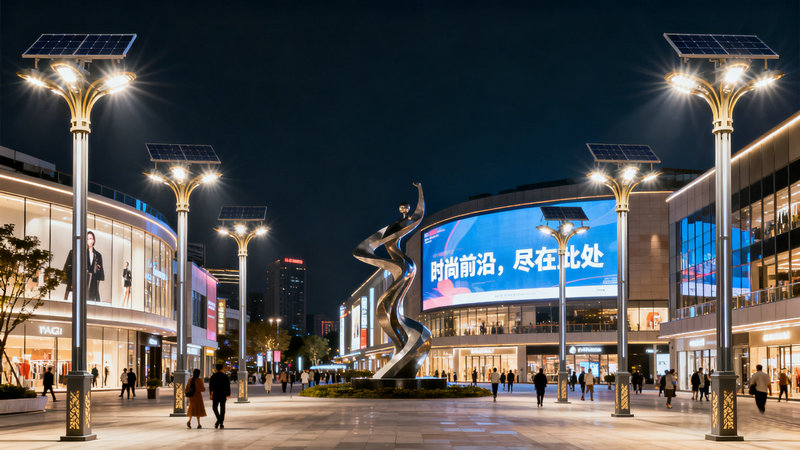
Case 1: 5,000㎡ Commercial Plaza Solar Lighting Project
Project Background
A 5,000㎡ urban commercial plaza covers pedestrian streets, a central square, and outdoor storefronts. Its original lighting system used 100 high-pressure sodium lamps (150W each), with three key pain points: ① Annual electricity costs exceeded $21,500; ② Severe light decay required bulb replacement every 6 months, with annual maintenance costs around $2,150; ③ Lighting flickered in some areas due to aging circuits. To align with global “dual carbon” goals and reduce operational costs, the plaza management decided to upgrade to a solar lighting system, with core requirements: “high brightness, long battery life, intelligent control, and commercial scene adaptability.”
Product Selection Plan
For the high-frequency use, large coverage area and multi-scenario needs of the commercial plaza, the selection is as follows:
- Pedestrian Streets: 189 20W solar courtyard lights (monocrystalline silicon panel with 24% conversion efficiency; 12V/20Ah lithium battery; 4000K neutral white light with 12-15m irradiation radius; 4m-high lamp pole with 12-level wind resistance)
- Central Square: 56 50W solar floodlights (polycrystalline silicon panel with 22% conversion efficiency; 12V/50Ah lithium battery; high-brightness LED chips with 130lm/W luminous efficiency; support remote dimming with 0-100% brightness adjustable)
- Outdoor Storefronts: 78 15W solar wall lights (monocrystalline silicon panel with 23% conversion efficiency; 12V/15Ah lithium battery; 3500K warm white light with anti-glare design, no impact on internal store lighting)
Intelligent System: Equipped with a centralized control system that supports remote monitoring (light working status, battery power) via mobile APP/computer, timing on/off, brightness adjustment and fault alarm functions.
Installation & Usage Effects
Installation Process: Prior on-site surveys optimized solar panel angles (30° south-facing) based on local sunshine conditions (average 5.5 hours/day). Lights were spaced 1.5x their irradiation radius to avoid dark zones—189 courtyard lights for pedestrian streets (1 per 25㎡), 56 floodlights for the central square (1 per 90㎡), and 78 wall lights for storefronts. Prefabricated concrete bases minimized ground damage, and the 7-day construction period avoided disrupting plaza operations.
Lighting Effect: The average illuminance of pedestrian streets is 50Lux, meeting the safety needs of pedestrians; the central square has uniform brightness, which can be adjusted according to event needs (50% brightness for daily use, 100% brightness for holidays); the light at storefronts is soft, enhancing the night consumption atmosphere.
Stability Performance: After extreme weather such as heavy rain and typhoon, the lights were not damaged or malfunctioning; they could still work normally for 4 consecutive cloudy/rainy days (brightness automatically reduced to 70% to ensure basic lighting).
Energy-Saving & Environmental Benefits
- Electricity Savings: Original sodium lamps consumed 54,750 kWh/year (100 units × 0.15kW × 10h/day × 365 days). At a commercial electricity rate of $0.39/kWh, annual costs reached $21,500. The solar system eliminates electricity bills, saving ≈$215,000 over 10 years.
- Maintenance Cost: LED lifespan ≥50,000 hours. For 323 solar lights, only 1-2 faulty components (e.g., batteries, LED beads, $20/unit) are replaced yearly, cutting annual maintenance costs to under $140—saving ≈$2,010/year vs. the original system.
- Environmental Impact: Reduces CO₂ emissions by ≈49 tons/year (54,750 kWh × 0.9kg/kWh), equivalent to saving 17 tons of standard coal (2.86 tons CO₂/ton coal) or planting 2,700 adult trees (18kg CO₂ absorption/tree/year).
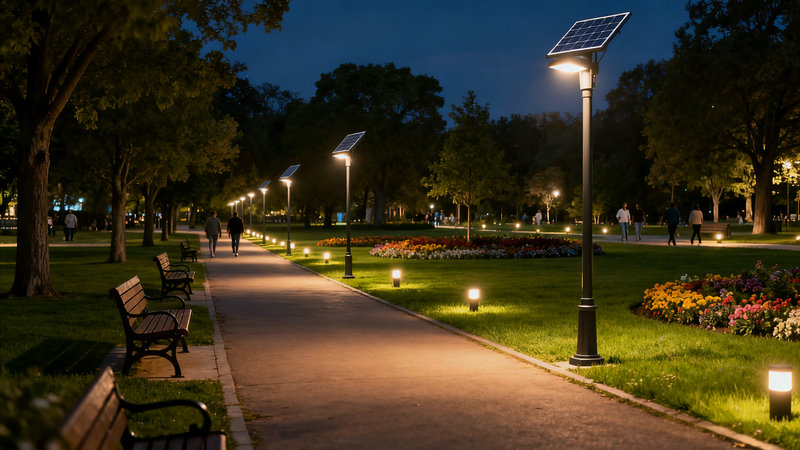
Case 2: 10,000㎡ Urban Park Solar Lighting System Construction
Project Background
A 10,000㎡ city park includes main roads, fitness trails, children’s play areas, and a lakeside landscape zone. Its original 50 municipal street lamps (100W each) had issues: ① High wiring costs ($11,500 during initial construction); ② Annual electricity bills ≈$14,300; ③ Plain designs clashed with the natural landscape. To enhance night aesthetics, safety, and cost-efficiency, the park management built a full solar lighting system, prioritizing “aesthetic design, natural integration, long battery life, and reliability.”
Product Selection Plan
Combining the park’s “natural and ecological” design concept, the selection balances practicality and aesthetics:
- Main Roads: 178 25W solar courtyard lights (monocrystalline panel, 23% efficiency; 12V/30Ah LiFePO₄ battery; 3000K warm white, 15-18m irradiation radius). 5m-tall wooden-textured poles align with the natural environment, spaced 4.5m along 800m-long roads.
- Fitness Trails: 87 8W solar path lights (polycrystalline panel, 21% efficiency; 3.2V/8Ah battery; 3500K neutral white). 2.5m-tall anti-glare poles spaced 14m along 1200m trails.
- Children’s Play Area: 35 12W solar cartoon lights (monocrystalline panel, 22% efficiency; 3.7V/10Ah battery; 2700K warm yellow, flicker-free). IP66 rating and rounded poles ensure safety.
- Lakeside Zone: 206 6W underwater lights (IP68, 0-1.5m depth) + 10 10W floodlights. Lights create a “lake reflection” effect, controlled by light sensors.
Installation & Usage Effects
Installation Process: Solar panels were installed in open areas of the park (avoiding tree shade) with adjustable brackets (to adjust the sun angle according to seasons); lamps were installed away from high-traffic areas, and lamp pole bases were fixed with expansion bolts (reducing damage to vegetation); underwater lights were waterproof tested before installation to ensure no leakage. To avoid affecting tourists, construction in core areas was carried out at night, and the entire process took two weeks.
Lighting Effect: The main roads have sufficient brightness (average illuminance 45Lux) to ensure the safety of tourists at night; the fitness trails have soft lighting that does not affect sports vision; the children’s play area has warm lighting that enhances the play experience; the lakeside landscape zone creates a “light reflecting on the lake” night scene effect through the combination of floodlights and underwater lights, becoming a park check-in spot.
Safety Performance: All lamps use low-voltage power supply (12V/3.2V) to eliminate electric shock risks; they have lightning protection, leakage protection and overload protection functions, and have been in operation for 1 year without safety accidents.
Energy-Saving & Environmental Benefits
- Electricity Savings: Original lamps consumed 14,600 kWh/year (50 units × 0.1kW × 8h/day × 365 days). At a municipal rate of $0.98/kWh, annual costs were ≈$14,300. The solar system saves ≈$143,000 over 10 years.
- Landscape Value: 516 solar lights (wooden-textured, cartoon, underwater designs) blend with nature. Night scenes like “lake reflections” and “trail star chains” became popular check-ins, boosting night visits by 30%.
- Environmental Impact: Reduces CO₂ emissions by ≈13 tons/year (14,600 kWh × 0.9kg/kWh), equivalent to saving 4.5 tons of standard coal or planting 720 adult trees.
Core Advantages of Solar Courtyard Lights
- Energy & Cost Efficiency: Solar-powered with zero electricity bills; reduces CO₂ emissions by 13-49 tons/year per project, aligning with global ESG standards.
- Easy Installation: No underground wiring needed—cuts construction time by 50% vs. traditional systems (7 days for 5,000㎡ plazas, 14 days for 10,000㎡ parks).
- Intelligent & Adaptive: Light/timer/remote control (English app interface); 70% brightness mode for cloudy days; works in -20°C to 60°C environments.
- Safe & Durable: Low-voltage (≤12V) design eliminates electric shock risks; IP65/IP68 ratings resist rain, typhoons, and corrosion; CE/RoHS certified.
- Low Maintenance: LED lifespan ≥50,000 hours; LiFePO₄ batteries last 3-5 years; only 1-2 annual cleanings for solar panels.
Solar Courtyard Light Purchase & Installation Suggestions
Purchase Points
- Power Selection: 5-15W for parks/residential yards, 20-50W for commercial plazas/large parks, 3-8W for trails—match wattage to area size (e.g., 20W per 25㎡).
- Battery Type: Prioritize LiFePO₄ batteries (≥2,000 cycles, safer than lead-acid) for long-term reliability.
- Solar Panel: Monocrystalline (22-24% efficiency) for low-light areas; polycrystalline (20-22%) for sunny regions.
- Protection Rating: IP65+ for outdoor use, IP68 for underwater applications.
- Certifications: Choose CE/FCC/RoHS certified products for global markets; ensure compliance with local standards (e.g., UL for North America).
Installation Notes
- Solar Panel Installation: Choose an unobstructed, sunlit location (average daily sunshine ≥4h), install south-facing, and set the tilt angle consistent with the local latitude (to improve power generation efficiency);
- Light Layout: Arrange lights at 1.5x the irradiation radius to avoid dark zones; adjust the height according to power (2.5-4m for 5-15W lamp poles, 4-6m for 20-50W lamp poles);
- Foundation Construction: Lamp pole bases must be fixed firmly (concrete pouring or expansion bolt fixing) with wind resistance ≥10 levels;
- Wiring Connection: Ensure correct positive and negative pole connection, and do a good job of waterproof treatment at joints (wrap with waterproof tape + heat shrink tube).
Conclusion
As a “green outdoor lighting solution,” solar courtyard lights reduce costs, enhance aesthetics, and improve safety—ideal for residential, commercial, and public spaces. Our products feature CE/RoHS/FCC certifications and support global projects with on-site surveys, English installation guides, and 2-year warranties. Whether upgrading a commercial plaza or building a park lighting system, solar technology offers a sustainable, cost-effective choice for the future. Contact us for customized overseas project solutions.