
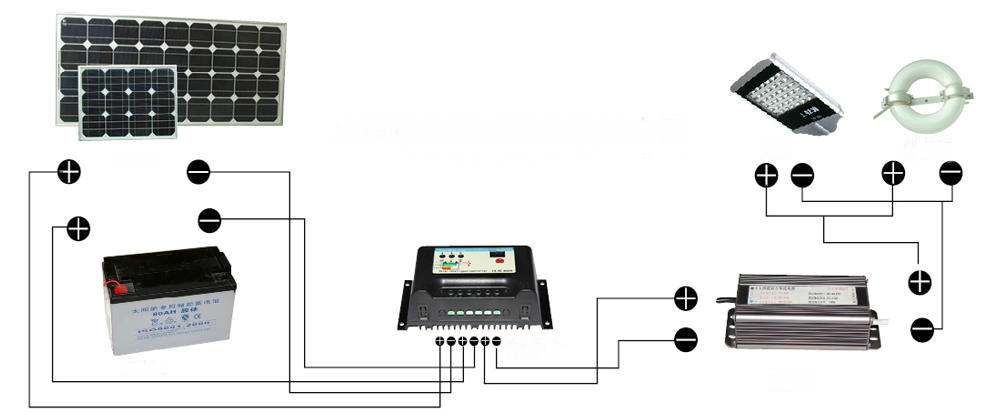
Comparison between Solar Lighting System and Ordinary Luminaires
In order to enable everyone to have a more comprehensive understanding of the solar lighting system, we will conduct a comparative analysis of solar lawn lights, solar courtyard lights, solar street lights with ordinary lawn lights, ordinary courtyard lights, and ordinary street lights as follows:
1. Economic Benefit Analysis
The simplicity of economic benefit analysis lies in the possibility of using statistical methods to solve problems clearly. Below, we have calculated data in five aspects: luminaire price, installation cost, supporting cost, usage consumption, and safety performance in the form of tables, and we will compare the following two examples.
Comparison Case 1
For road construction in a certain development zone, 100 sets of 250W street lights need to be installed, with a spacing of 50 meters between two lights, using VV3×25+2×16 cables plus casings, taking 10 years of use as an example.
| Item | Quantity | Unit Price | Total |
|---|---|---|---|
| Ordinary Street Light | 100 sets | 2,600 CNY | 260,000 |
| Solar Street Light | 100 sets | 16,000 CNY | 1,600,000 |
| Pipeline Laying | 5,500 meters | 180 CNY/meter | 990,000 |
| Supporting Cost | – | – | 28,000 |
| Electricity Fee | 250W×10 hours×365 days×10 years | – | 456,250 |
| 100 sets | 600 CNY/year | 600,000 | |
| Maintenance Cost | 100 sets | 600 CNY/10 years | 60,000 |
| Mainly Replacing Batteries | 100 units | 1,800 CNY/10 years | 180,000 |
| Ordinary Street Light | 10-year total cost | – | 4,121,250 |
| Solar Street Light | 10-year total cost | – | 1,780,000 |
Comparison Case 2
For the construction of a certain square, 40 sets of 100W courtyard lights need to be installed, with a spacing of 40 meters between two lights, using VV3×16+2×10 cables, taking 10 years of use as an example.
| Item | Quantity | Unit Price | Total |
|---|---|---|---|
| Ordinary Courtyard Light | 40 sets | 1,500 CNY | 60,000 |
| Solar Courtyard Light | 40 sets | 6,000 CNY | 240,000 |
| Pipeline Laying | 1,600 meters | 85 CNY/meter | 136,000 |
| Supporting Cost | – | – | 3,000 |
| Electricity Fee | 100W×10 hours×365 days×10 years | – | 146,000 |
| 40 sets | 1,000W×0.5 CNY | 73,000 | |
| Maintenance Cost | 40 sets | 600 CNY/10 years | 24,000 |
| Mainly Replacing Batteries | 40 units | 1,200 CNY/10 years | 48,000 |
| Ordinary Courtyard Light | 10-year total cost | – | 313,000 |
| Solar Courtyard Light | 10-year total cost | – | 288,800 |
Basic Conclusions
From the above two tables, the following basic conclusions can be drawn:
- In terms of the product itself, the cost of solar luminaires is higher than that of ordinary luminaires.
- In this case, if the costs incurred during the entire construction process are taken into account, the initial investment in installing solar luminaires is basically the same as that of ordinary luminaires.
- The larger the scale, the higher the related costs for installing ordinary luminaires, and their initial investment will be higher than that of solar luminaires.
- In terms of operating costs, ordinary luminaires are significantly higher than solar luminaires, and will become more and more expensive (electricity fees, labor, etc.).
- In terms of use stability, solar luminaires are easily affected by weather and use environment (stability can be enhanced by changing the control method), and are currently not suitable for places with very strict lighting requirements.
In short, from a comprehensive comparison, the feature of solar luminaires saving investment is quite obvious.
II. Safety
Solar luminaires use safe direct current below 36V, so there will be no safety issues. Since ordinary luminaires use 380V AC power, the pipelines will age during the 10-year service period, posing serious safety hazards.
III. Social and Economic Benefits
It is certainly a good thing for a technology or a product to have economic benefits, but its vitality is directly related to whether it is compatible with social development and whether it has social benefits that surpass other products. The emergence of solar energy technologies and products meets the needs of social development and environmental requirements. The social benefits they bring are incomparable to ordinary products, and their vitality will definitely be vigorous and lasting.
To sum up, after the wandering period of solar lighting products in the past few years, the improvement of technology and the reduction of costs will eventually lead to a period of rapid development. And rapid development will definitely drive further technological improvement and further cost reduction. In such a virtuous circle, solar products will change the past situation of “being praised but not popular” and usher in new glory. Here, we are willing to work with governments at all levels and other enterprises to give full play to their respective advantages and make our own contributions to creating a clean and environmentally friendly new era!
The service life of solar luminaires is much longer than that of ordinary electric luminaires. For example, the main component of solar luminaires—the solar cell module—has a service life of more than 20 years; the average service life of low-pressure sodium lamps is 18,000 hours; the average service life of low-pressure high-efficiency three-primary color energy-saving lamps is 6,000 hours; the average service life of ultra-bright LEDs is 150,000 hours.